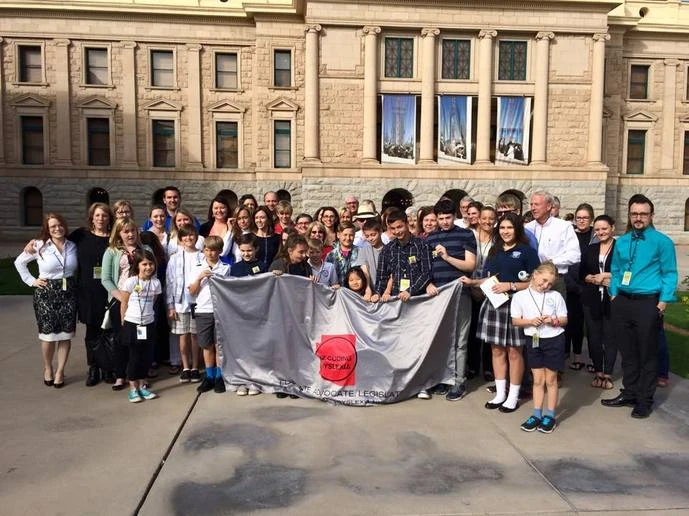
As our kids prepare to head back to school, it's a natural time for us to take stock of where Decoding Dyslexia Arizona is right now, and where we're heading. The campaign toward passage of SB 1461 was a tremendous, community-wide effort with gratifying results. But as anyone familiar with the struggles our kids with dyslexia face, our work is far from complete. Many students' reading challenges remain unidentified, and most are not receiving early or appropriate interventions. Parents' frustration levels continue to rise as they watch their children flounder, year after year.
Where are we now?
Decoding Dyslexia Arizona began with five goals, and we're delighted that passage of SB 1461 resulted in our achieving the first one: "a universal definition and understanding of 'dyslexia' in the state education code." We hope this provision will support parents who are told that our public schools do not "recognize" dyslexia.
We've also taken a small step toward the second goal -- "mandatory teacher training on dyslexia, its warning signs and appropriate intervention strategies." Although SB 1461 does not make teacher training mandatory, it does provide incentives in the form of professional development credit for teachers who choose to learn more about dyslexia.
And although it was not one of our original goals, we were successful in changing the law so that third graders with a diagnosis of dyslexia who perform poorly on the statewide, annual reading test cannot be held back. We felt this was an important interim step to protect children (who had not received appropriate intervention) from the stigma of grade retention.
Unfortunately, we were unable to get any further. You may be aware that the version of SB 1461 that was initially introduced would have included mandatory dyslexia screening and remediation programs across the state. As the 2015 legislative session began to unfold, however, it became clear that a bill of this nature would not have enough political support to pass. Under the circumstances, we scaled back our efforts in the hope that slow progress would be better than no progress at all.
What's next?
Having taken these baby steps, the obvious question is, what do we do now? Before discussing where we're heading, it's important to take a look at the context in which the dyslexia community finds itself.
At the state policy level, Superintendent Diane Douglas, the elected head of the Arizona Department of Education, is the target of a recall effort. She's also engaged in a legal battle to exert control over the chief of staff of the Arizona State Board of Education, causing tension throughout the ADE and possibly with Governor Ducey and his office. Who's actually in charge of education in our state is really anyone's guess. Thrown into this apparent leadership void is an overall preference among policymakers for "local control" of education and a resistance to "top down" and "prescriptive" rules and policies.
Economically, there is also a widespread belief among supporters of public schools that the Governor's 2015 education budget, which the legislature adopted, provides insufficient funds to meet our kids' needs. Our state ranks 50th in how much it spends per pupil on K-12 education. Teachers, whose salaries also rank near the bottom nationally, are "fleeing in droves."
At the federal level, things are also in flux. Congress has been engaged in a heated debate about what should be included in a bill reauthorizing the Elementary and Secondary Education Act ("ESEA"). This is a major statute that essentially provides the whole structure under which public schools operate across the country. The House and Senate have each passed a version of the bill, and toward the end of the year they will attempt to craft a compromise that will pass both chambers and be signed by the President.
Our agenda for 2015-2016
Given the uncertainty surrounding education policy at all levels, we have decided that in the next legislative session, we will not pursue any dyslexia-specific legislation. Instead, we will lend our support (in a non-partisan manner) to legislative efforts that in our best judgment, after consulting with other public education advocates, would result in increased funding for Arizona public schools. We hope you will continue to be involved and lend your voice to this important cause. Look for email "action alerts" and updates on and .
Of course we also will continue our efforts to support the dyslexia community in other ways by holding parent meetings and discussion groups and providing whatever information, support and resources we can. If and when we perceive greater clarity and an appropriate opening, we will return to exploring potential public policy solutions to our students' challenges.
Decoding Dyslexia Arizona remains an organic, grassroots group of volunteers, and we welcome your ideas, suggestions, input and energy.
Onward!
Meriah Houser
Jenifer Kasten
Where are we now?
Decoding Dyslexia Arizona began with five goals, and we're delighted that passage of SB 1461 resulted in our achieving the first one: "a universal definition and understanding of 'dyslexia' in the state education code." We hope this provision will support parents who are told that our public schools do not "recognize" dyslexia.
We've also taken a small step toward the second goal -- "mandatory teacher training on dyslexia, its warning signs and appropriate intervention strategies." Although SB 1461 does not make teacher training mandatory, it does provide incentives in the form of professional development credit for teachers who choose to learn more about dyslexia.
And although it was not one of our original goals, we were successful in changing the law so that third graders with a diagnosis of dyslexia who perform poorly on the statewide, annual reading test cannot be held back. We felt this was an important interim step to protect children (who had not received appropriate intervention) from the stigma of grade retention.
Unfortunately, we were unable to get any further. You may be aware that the version of SB 1461 that was initially introduced would have included mandatory dyslexia screening and remediation programs across the state. As the 2015 legislative session began to unfold, however, it became clear that a bill of this nature would not have enough political support to pass. Under the circumstances, we scaled back our efforts in the hope that slow progress would be better than no progress at all.
What's next?
Having taken these baby steps, the obvious question is, what do we do now? Before discussing where we're heading, it's important to take a look at the context in which the dyslexia community finds itself.
At the state policy level, Superintendent Diane Douglas, the elected head of the Arizona Department of Education, is the target of a recall effort. She's also engaged in a legal battle to exert control over the chief of staff of the Arizona State Board of Education, causing tension throughout the ADE and possibly with Governor Ducey and his office. Who's actually in charge of education in our state is really anyone's guess. Thrown into this apparent leadership void is an overall preference among policymakers for "local control" of education and a resistance to "top down" and "prescriptive" rules and policies.
Economically, there is also a widespread belief among supporters of public schools that the Governor's 2015 education budget, which the legislature adopted, provides insufficient funds to meet our kids' needs. Our state ranks 50th in how much it spends per pupil on K-12 education. Teachers, whose salaries also rank near the bottom nationally, are "fleeing in droves."
At the federal level, things are also in flux. Congress has been engaged in a heated debate about what should be included in a bill reauthorizing the Elementary and Secondary Education Act ("ESEA"). This is a major statute that essentially provides the whole structure under which public schools operate across the country. The House and Senate have each passed a version of the bill, and toward the end of the year they will attempt to craft a compromise that will pass both chambers and be signed by the President.
Our agenda for 2015-2016
Given the uncertainty surrounding education policy at all levels, we have decided that in the next legislative session, we will not pursue any dyslexia-specific legislation. Instead, we will lend our support (in a non-partisan manner) to legislative efforts that in our best judgment, after consulting with other public education advocates, would result in increased funding for Arizona public schools. We hope you will continue to be involved and lend your voice to this important cause. Look for email "action alerts" and updates on and .
Of course we also will continue our efforts to support the dyslexia community in other ways by holding parent meetings and discussion groups and providing whatever information, support and resources we can. If and when we perceive greater clarity and an appropriate opening, we will return to exploring potential public policy solutions to our students' challenges.
Decoding Dyslexia Arizona remains an organic, grassroots group of volunteers, and we welcome your ideas, suggestions, input and energy.
Onward!
Meriah Houser
Jenifer Kasten
 RSS Feed