
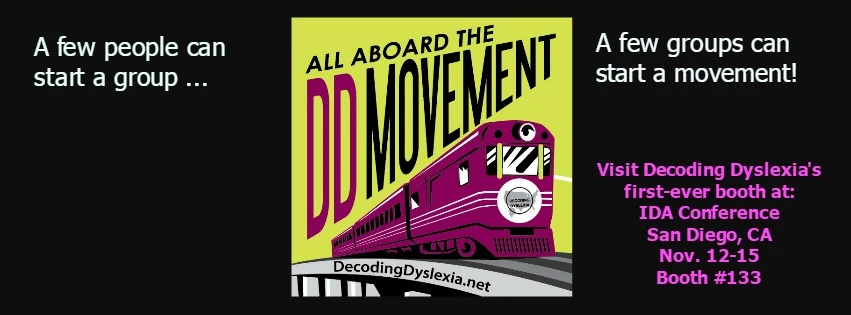
Last week in San Diego, we joined Decoding Dyslexia parents from throughout the United States and Canada for the annual conference of the International Dyslexia Association. Collectively, Decoding Dyslexia created an undeniable parent presence at a conference that historically has catered mostly to educators, researchers, and related professionals. Parent representatives from as far away as New Hampshire, Florida, and even Ontario came to connect and share strategies for improving the availability of educational resources for our children.
We learned a lot about brain research, co-occurring disabilities, and testing accommodations, to name only a few topics. But if we had to describe one theme that pervaded our time in San Diego, it would be the importance of building relationships with others who care about the welfare of our children. And at the very top of the list...? Teachers.
We all agreed that although Decoding Dyslexia is a parent-led movement, it is not a parent-only movement; it is a movement, plain and simple. Dyslexia is real, it's common, there's lots of stuff that works to help kids with dyslexia learn to read, and they deserve the chance to do so.
Nevertheless, many of us have encountered obstacles to forging meaningful alliances with teachers on the subject of dyslexia. To start, most teachers -- even special education teachers -- do not learn about dyslexia in any substantial or material way in college or graduate school or as part of the teacher certification process. So they're either skeptical of its legitimacy as a "thing" or anxious about how to deal with it.
Some, we hear, are explicitly told (mistakenly or not) that the law does not "recognize" dyslexia, and therefore children with dyslexia do not have a right to special education services. Still others seem to be under budgetary or other pressures to avoid identifying children for special education of any kind. For whatever reason, even with the most caring, sympathetic, and talented of teachers, we feel we must whisper "the D word" behind closed doors, hoping that no one is listening, and that we won't inadvertently jeopardize anyone's career.
What is particularly frustrating about this situation is that teachers, we believe, can make an enormous impact by working inside "the system." We parents can "push in" from the outside, but if teachers also gently "push out" from the inside -- WOW! Imagine what we could do, together, to raise awareness and begin to change the conversation.
So for all you amazing, dedicated, passionate teachers out there, we hope you will join this growing movement. What does that mean? If you're already well-versed in dyslexia, think about ways you might be able to share your knowledge within your school or even your district. If all this is new to you, consider taking some time to check out some of the resources we list on our website, and share them with your colleagues.
There are also some terrific documentaries about dyslexia that are available online and through Netflix. Grab a bowl of popcorn and invite some friends over to enjoy (We promise they're not boring! One of them -- The Big Picture -- actually premiered at the Sundance Film Festival. And Harvey Hubbell's Dislecksia is hilarious and entertaining.) Keep up with our activities by following us on Facebook and Twitter. Invite us to give a dyslexia simulation or "What is Dyslexia?" presentation at your school.
Most importantly, advise us: what, if anything, can we parents do to support you in your efforts to bring the undisputed, scientific facts about dyslexia to your community? How can we work together to make a difference?
We learned a lot about brain research, co-occurring disabilities, and testing accommodations, to name only a few topics. But if we had to describe one theme that pervaded our time in San Diego, it would be the importance of building relationships with others who care about the welfare of our children. And at the very top of the list...? Teachers.
We all agreed that although Decoding Dyslexia is a parent-led movement, it is not a parent-only movement; it is a movement, plain and simple. Dyslexia is real, it's common, there's lots of stuff that works to help kids with dyslexia learn to read, and they deserve the chance to do so.
Nevertheless, many of us have encountered obstacles to forging meaningful alliances with teachers on the subject of dyslexia. To start, most teachers -- even special education teachers -- do not learn about dyslexia in any substantial or material way in college or graduate school or as part of the teacher certification process. So they're either skeptical of its legitimacy as a "thing" or anxious about how to deal with it.
Some, we hear, are explicitly told (mistakenly or not) that the law does not "recognize" dyslexia, and therefore children with dyslexia do not have a right to special education services. Still others seem to be under budgetary or other pressures to avoid identifying children for special education of any kind. For whatever reason, even with the most caring, sympathetic, and talented of teachers, we feel we must whisper "the D word" behind closed doors, hoping that no one is listening, and that we won't inadvertently jeopardize anyone's career.
What is particularly frustrating about this situation is that teachers, we believe, can make an enormous impact by working inside "the system." We parents can "push in" from the outside, but if teachers also gently "push out" from the inside -- WOW! Imagine what we could do, together, to raise awareness and begin to change the conversation.
So for all you amazing, dedicated, passionate teachers out there, we hope you will join this growing movement. What does that mean? If you're already well-versed in dyslexia, think about ways you might be able to share your knowledge within your school or even your district. If all this is new to you, consider taking some time to check out some of the resources we list on our website, and share them with your colleagues.
There are also some terrific documentaries about dyslexia that are available online and through Netflix. Grab a bowl of popcorn and invite some friends over to enjoy (We promise they're not boring! One of them -- The Big Picture -- actually premiered at the Sundance Film Festival. And Harvey Hubbell's Dislecksia is hilarious and entertaining.) Keep up with our activities by following us on Facebook and Twitter. Invite us to give a dyslexia simulation or "What is Dyslexia?" presentation at your school.
Most importantly, advise us: what, if anything, can we parents do to support you in your efforts to bring the undisputed, scientific facts about dyslexia to your community? How can we work together to make a difference?
 RSS Feed